Tree Removal Tools and Techniques: How Professionals Decide How a Tree Comes Down
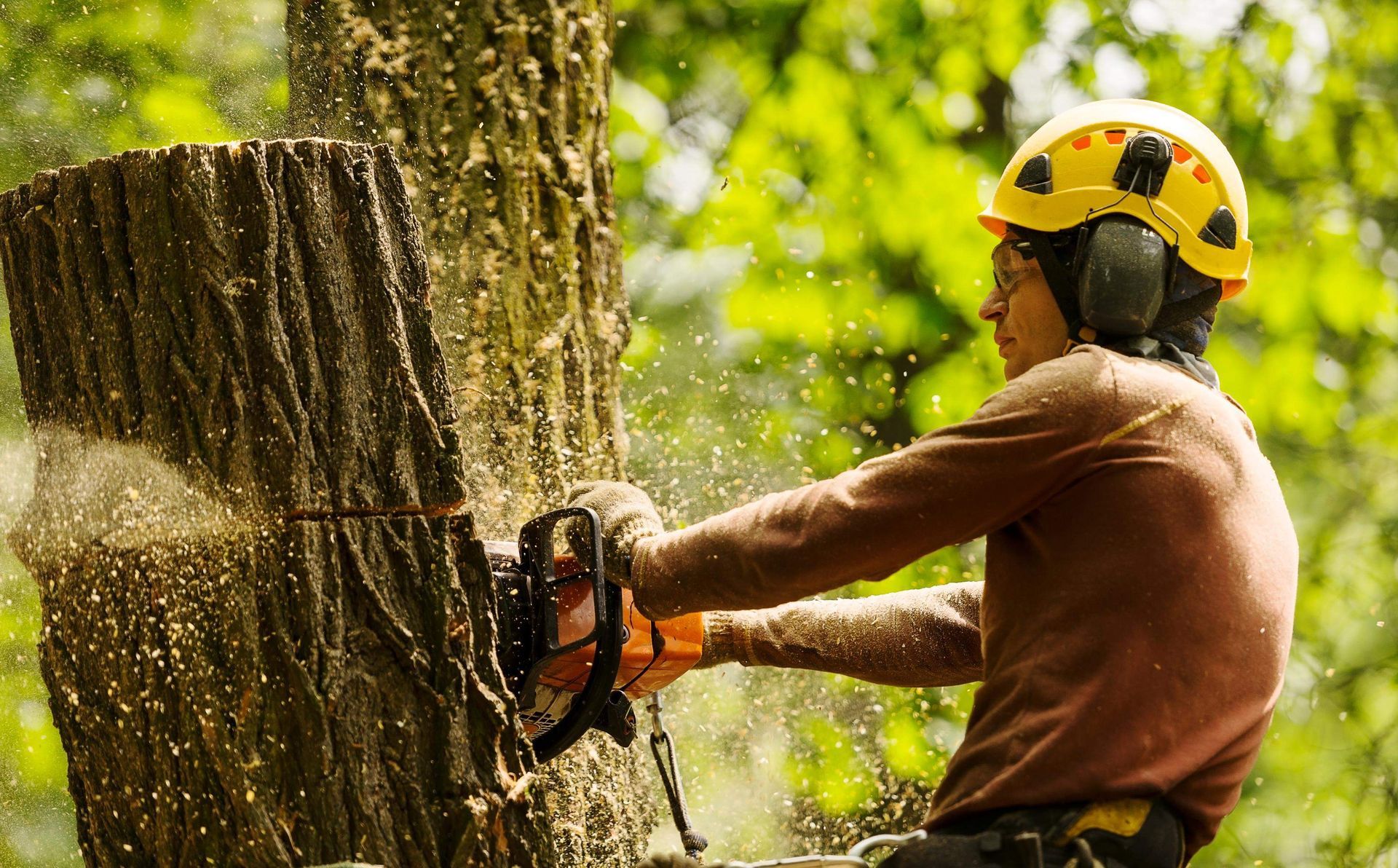
Table of Contents
- Introduction
- The Site Picks the Method, Not the Tree
- Directional Felling and the Hinge That Actually Steers It
- Sectional Dismantling: Why Most Residential Removals Look Like This
- Rigging, and Why a Rope From the Hardware Store Is Not One
- Cranes and Aerial Lifts: Sometimes the Cheaper Option
- Why a Dead Tree Can Cost More Than a Healthy One
- The Saw Is the Smallest Part of the Job
- What Chippers and Grinders Actually Handle
- The Safety Equipment That Does Real Work
- Assessment Tools That See Inside the Trunk
- Power Lines Change the Answer Entirely
- Why Homeowner Attempts Go Wrong
- Conclusion
- Talk Through How Your Tree Would Come Down
- Frequently Asked Questions
Key Takeaways
- Method is dictated by the site, not the species or the size. The first question is whether a drop zone exists that is longer than the tree is tall.
- Directional felling works because of the hinge, a strip of uncut wood left between the notch and the back cut. Cutting through the hinge removes all control over where the tree goes.
- Sectional dismantling is the standard residential approach and is far more labor intensive than felling, which explains most of the cost difference between two similar looking jobs.
- Rigging generates forces several times the static weight of the piece being lowered, which is why hardware store rope and improvised anchors fail.
- A crane costs more to mobilize but can turn a two day rigging job into a few hours, so it is sometimes the cheaper choice rather than the expensive one.
- A dead or decayed tree often costs more to remove than a healthy one of the same size, because it cannot be safely climbed and requires mechanical access instead.
- Chippers handle brush, not trunk wood. Moving trunk sections is usually the labor bottleneck and the reason full haul away costs more.
Introduction
Professional tree removal comes down to one decision made before any saw starts: whether the tree can be felled in one piece, dismantled in sections by a climber, or picked apart with a crane or lift. Everything else, including which tools come off the truck, follows from that call.
Most articles on this topic read like an equipment catalog. Chainsaws, chippers, stump grinders, climbing gear. That list tells a homeowner nothing useful, because the tools are not what separates a safe removal from a dangerous one. The sequence is. A crew with excellent equipment and a bad plan is more dangerous than a crew with basic equipment and a good one.
This matters if you are looking at a quote and wondering why the number is what it is. In the Grand Valley and around Montrose, most removals are mature cottonwood, Siberian elm, silver maple, ash, spruce, and old fruit trees, and most of them sit on lots with fences, irrigation lines, service drops, and neighbors close by. That combination rules out the fast method almost every time. Understanding how a tree removal is actually planned makes it far easier to read an estimate and to tell a solid approach from an optimistic one.
What follows is the decision process, the techniques it produces, and what each one demands.
The Site Picks the Method, Not the Tree
Before anything else, the crew is answering one question: where does the wood go?
Is there a clear drop zone longer than the tree is tall, with margin? Trees do not always land exactly where intended, and a trunk can slide or kick off the stump. If that space genuinely exists and nothing valuable is in it, the tree can be felled whole. This is the fastest and cheapest method by a wide margin. On residential lots it is rarely available.
If not, can the tree be safely climbed and rigged? If the wood is sound enough to hold anchor points and the surrounding space allows pieces to be lowered, a climber dismantles it from the top down. This is the standard residential approach.
If it cannot be climbed, or the pieces are too heavy to rig, can machinery reach it? A crane, an aerial lift, or a grapple truck takes over. This requires access for the machine, which is its own constraint.
If none of those work, the job gets complicated and expensive, and that is worth knowing before you get three quotes that seem irreconcilable.
The useful thing for a homeowner: a bid dramatically lower than the others sometimes reflects a plan to fell a tree into a space that does not really accommodate felling. Asking directly how they intend to take it down and where the pieces will land tends to surface that.
Directional Felling and the Hinge That Actually Steers It
Felling is often described as "aiming" at a tree. It is more specific than that, and the specifics are the whole technique.
A notch is cut into the side facing the intended direction of fall, removing a wedge of wood. Then a back cut is made from the opposite side, slightly above the base of the notch. The back cut is deliberately stopped short.
The wood left between the back cut and the notch is the hinge, and the hinge is what steers the tree. It stays attached as the tree goes over, controlling direction and slowing rotation. Hinge thickness and evenness determine where the tree ends up. Cut through the hinge and the tree is no longer being guided by anything.
A few things follow from this that are not obvious:
- An uneven hinge pulls the tree sideways, which is how trees end up somewhere other than planned.
- The back cut sits above the notch apex for a reason. Below it, the hinge cannot function properly.
- Wedges or a felling jack are often driven into the back cut to push the tree past its lean.
- A tree leaning hard in the wrong direction may not be fellable in the desired direction at all, regardless of technique.
Barber chair is the failure mode worth knowing about. On a tree under forward tension, a conventional back cut can allow the trunk to split vertically upward, and the butt kicks back and up toward the sawyer with enormous force. It is frequently fatal. Preventing it requires bore cutting or a snap cut so the holding wood releases at once rather than progressively. This is a large part of why a heavily leaning tree is not a beginner's project.
Sectional Dismantling: Why Most Residential Removals Look Like This
When there is no drop zone, the tree comes apart from the top down.
A climber ascends on rope, establishing anchor points in sound wood, and works downward removing limbs, then trunk sections. Each piece is either dropped into a clear space below or, more commonly, attached to a rigging line and lowered under control by a ground crew.
What makes this expensive is that it is slow and it is labor heavy. Every piece is individually assessed, cut, controlled, lowered, untied, dragged clear, and processed. A tree that would take forty minutes to fell in an open field can take a full crew most of a day when it sits between a house and a fence.
Two related techniques come up constantly:
Limbing is removing branches from the trunk, done in a sequence that keeps the remaining stem balanced and predictable.
Bucking is cutting the trunk into sections. The order matters, because wood under compression pinches a bar and wood under tension springs. Reading which is which before cutting is a core skill and the reason a bar gets stuck for an inexperienced sawyer.
The climber also has to think about what the tree does as it changes. Removing a large limb from one side alters the balance of everything above, and a stem that was stable becomes a different stem.
Rigging, and Why a Rope From the Hardware Store Is Not One
This is the least understood part of the work and where homeowner attempts most often turn serious.
Lowering a piece of wood on a line does not generate a force equal to its weight. It generates considerably more, because the piece falls a short distance before the line catches it, and stopping a moving mass multiplies the load. A section that weighs a few hundred pounds statically can spike to several times that at the anchor in the instant it is caught. Green wood is also far heavier than people expect, since it is full of water, and a limb someone imagines lifting by hand routinely weighs a few hundred pounds.
That is why professional rigging uses:
- Arborist specific rope with a known working load limit, not utility rope or tow strap
- Rigging blocks and friction devices that let a ground worker control the descent rather than absorb the shock directly
- Anchor points chosen for sound wood, since the anchor sees more force than anything else in the system
- Slings and hardware rated for the loads, with the whole system inspected
The two ways this fails badly for a homeowner are an anchor pulling out of decayed wood and a rope that parts under a shock load. Both put a heavy object in motion with no control, near people.
Cranes and Aerial Lifts: Sometimes the Cheaper Option
Homeowners generally assume a crane means the most expensive quote. It is not always true.
A crane picks whole sections out of a tree and sets them down in a controlled spot, often over a roof or a fence. The advantages are substantial: the piece is supported before it is cut rather than after, the climber is not relying on the tree's own integrity to hold rigging loads, and the work goes much faster.
Mobilizing a crane is expensive. But if it turns two days of rigging by a full crew into four hours, the total can land lower than the alternative. It also becomes the safe answer rather than merely the fast one when the trunk is decayed.
Aerial lifts, meaning bucket trucks and tracked lifts, serve a similar purpose at a smaller scale. They put a sawyer in position without climbing, which is faster and safer where the ground supports the machine and the access allows it. Backyard access is usually the limiting factor.
Why a Dead Tree Can Cost More Than a Healthy One
This surprises nearly everyone, and it follows directly from everything above.
Climbing a tree means trusting it. The anchor points, the stem you are tied into, the limbs you stand on. All of that assumes sound wood. A dead, hollow, or heavily decayed tree cannot be trusted for any of it. Decay is also difficult to gauge from the outside, so the safe assumption is the pessimistic one.
So the tree that most obviously needs to come out is frequently the one that cannot be dismantled the normal way. It requires a crane or a lift, which means mobilization cost and access requirements, or it requires a more conservative and slower approach from the ground.
If you have been told that removing a dead tree costs more than removing the healthy one beside it, that is why. It is not opportunism. It is that one of them can be climbed and the other cannot.
The Saw Is the Smallest Part of the Job
Chainsaws get most of the attention and deserve the least of it, because saw selection is routine while saw handling is not.
A crew typically carries several: a small top handle saw used one handed by a climber in the canopy, mid size saws for limbing, and a large saw with a long bar for the trunk. Matching bar length to the wood matters, and so does chain type and sharpness. A dull chain does not cut slower, it grabs, throws sawdust instead of chips, and increases kickback risk.
Kickback is worth understanding even if you never touch a saw. The upper quadrant of the bar nose is the kickback zone. Contact there can throw the bar up and back along its own plane, which is toward the operator's head and shoulder. That geometry is why chainsaw injuries cluster where they do, and why cutting with the tip, cutting above shoulder height, and cutting from a ladder are all specifically dangerous.
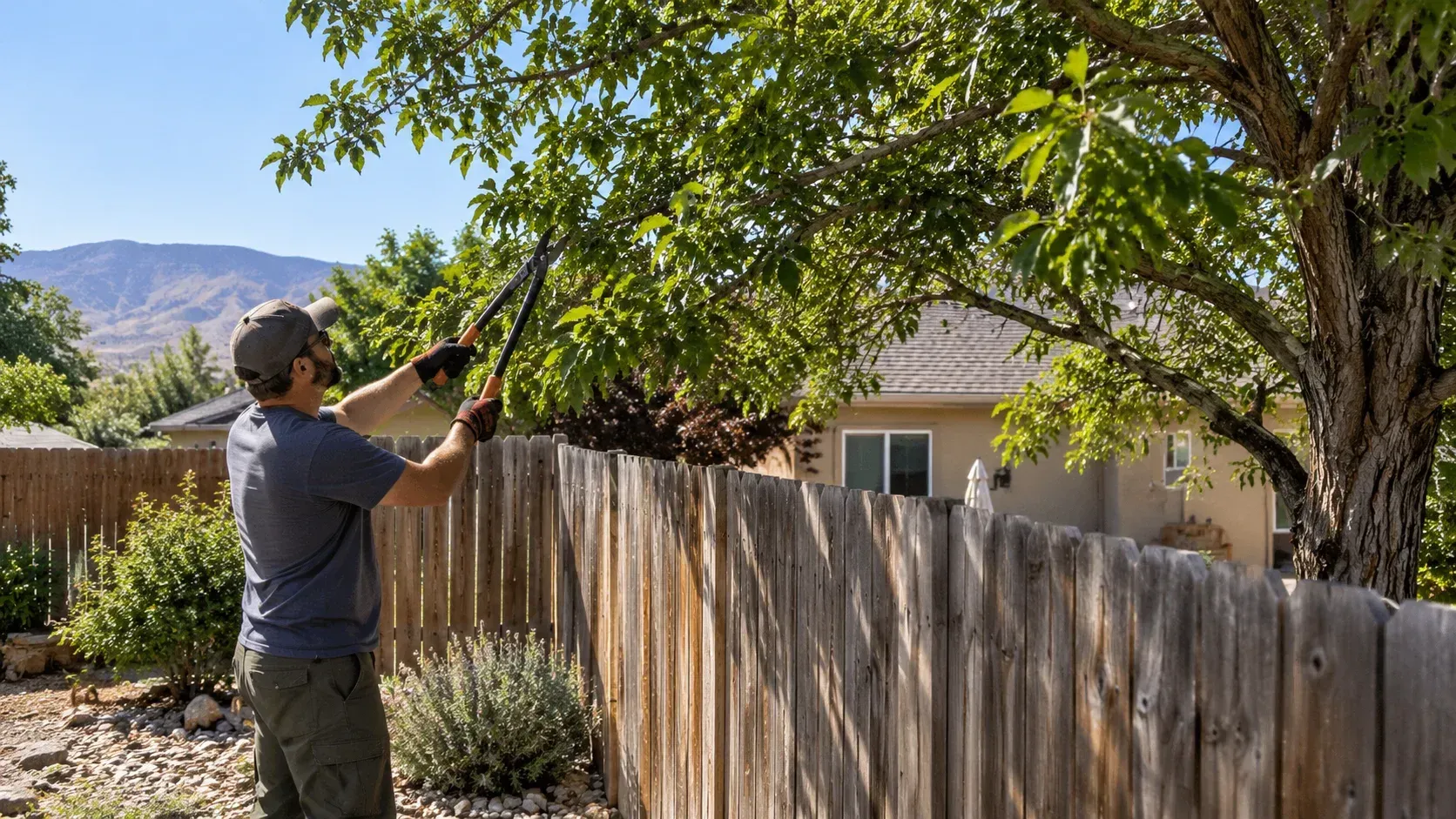
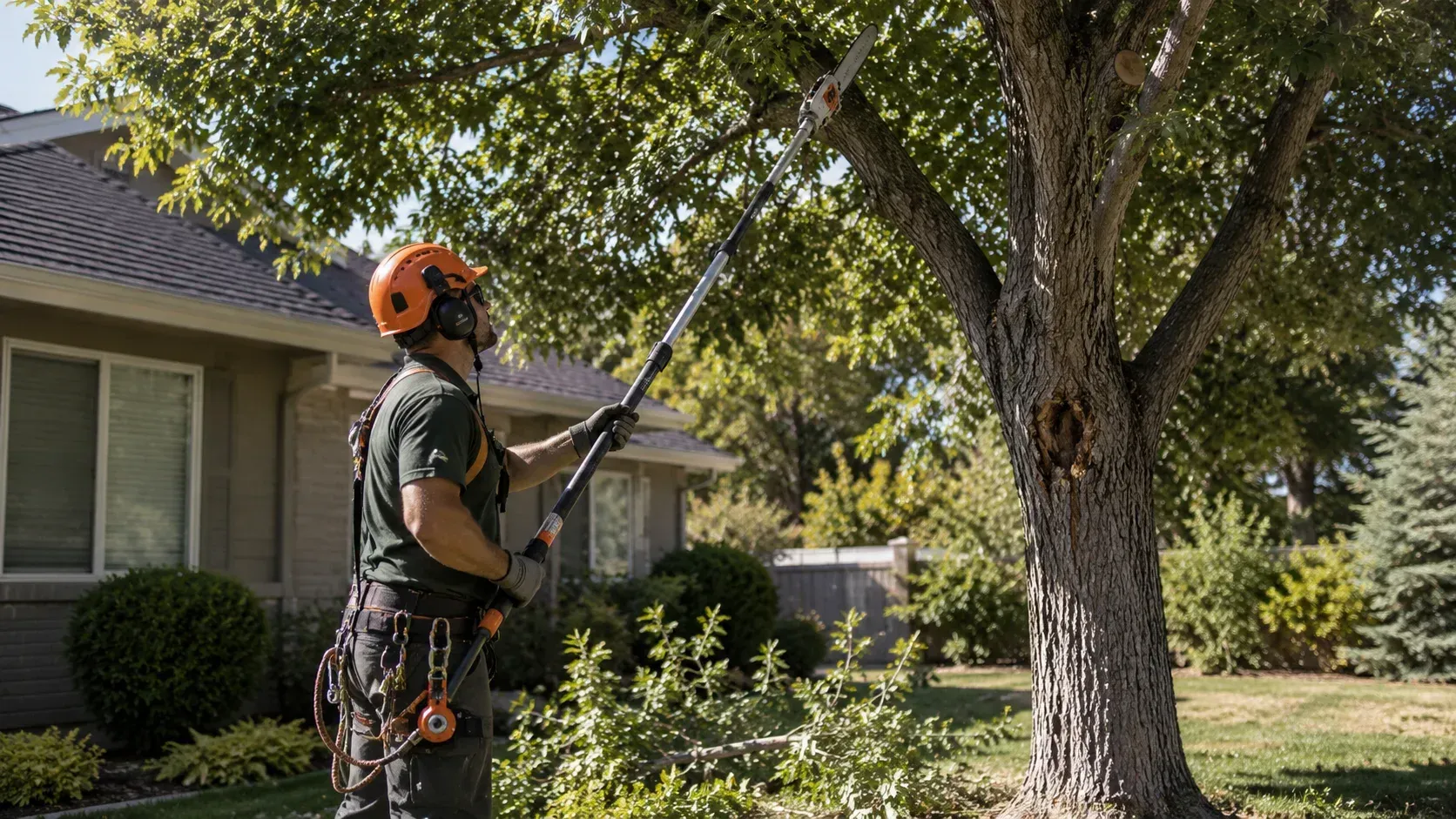
Pole saws extend reach from the ground for smaller limbs. They are useful and they are also how people get hurt working under limbs they have just cut, and near lines they misjudged.
Handsaws still have a place for precise cuts in tight spots, where a powered saw would be clumsy.
What Chippers and Grinders Actually Handle
Worth being clear about, because it drives cleanup costs.
Wood chippers process brush and limbs, typically up to a diameter limit set by the machine. They do not handle trunk wood. That means the trunk sections have to be bucked to a movable size and physically moved, which is often the slowest and most labor intensive part of the entire day. This is why "haul everything away" and "leave the rounds stacked" are meaningfully different prices.
Chippers are also among the most dangerous machines in the trade. Material is drawn in by feed rollers with real force. The safety rules exist because of specific accidents: feed the butt end first, never push material with hands or feet past the feed table, never wear loose clothing or gloves that can be caught, and know where the reverse bar is before starting. This is a genuine reason to think twice about renting one.
Stump grinders are separate equipment, brought for a separate task. The stump is not automatically included in a removal quote, and grinding is priced on its own variables including diameter at the root flare, depth, and access. There are specific reasons stump grinding costs vary so much from job to job, and it is worth settling whether it is in scope before work begins.
The Safety Equipment That Does Real Work
Most articles list PPE. Fewer explain why any of it works, which is the part that makes the point.
Chainsaw chaps and trousers are not padding. They contain long loose fibers that, when the chain contacts them, are pulled out and jam the drive sprocket, stalling the saw in a fraction of a second. That mechanism is the entire design, and it is why a chain that touches a leg through chaps usually stops before it reaches skin.
A helmet with an integrated face screen and ear muffs covers three exposures at once: falling material, thrown debris, and sustained noise well above safe levels.
Cut resistant boots with a protective toe, for the same reason as chaps plus the obvious.
Climbing systems including saddle, ropes, friction hitch or mechanical device, and lanyard, all inspected before use and retired on a schedule. Rope and hardware have service lives.
Site controls matter as much as the gear: a marked exclusion zone that people and pets stay out of, a clear escape route planned for every fell, and communication between the climber and the ground crew, since the person in the tree cannot see everything below.
Assessment Tools That See Inside the Trunk
Before a removal, someone needs to judge whether the tree can hold rigging loads or a climber at all. Visual inspection only goes so far, since bark grows over decay and a solid looking trunk can be substantially hollow.
Tools exist in the field for this. Resistance drilling pushes a fine needle through the trunk and records how much resistance it meets, producing a profile of sound and decayed wood along that path. Sonic tomography uses sensors around the trunk to map internal density. Mallet sounding, tapping the trunk and listening for a hollow tone, is the low tech version and is genuinely informative in experienced hands.
Worth being straightforward: these are specialty instruments and not every company owns them. Many removals do not need them. If a large tree over a structure is in question, it is fair to ask what the assessment was based on and whether an advanced assessment is warranted.
Power Lines Change the Answer Entirely
Nothing described above applies in the normal way once energized conductors are involved.
Working near lines requires specific line clearance training, defined minimum approach distances, and in many cases coordination with the utility itself. A skilled climber who has never done line clearance work is not qualified for it, and neither is a general tree crew by default.
Electricity does not require contact. It can arc across a gap and it travels readily through green wood and wet rope. A limb resting against a conductor is energized. The primary lines on the poles are generally the utility's responsibility and utilities will often handle clearance around them, while the service drop to the house occupies less clear territory that varies by provider. The right first call is the utility. The specifics of what makes tree work near power lines safe or unsafe are worth reading before accepting any quote that touches on one.
Why Homeowner Attempts Go Wrong
The failures follow a pattern, and it is rarely a lack of nerve or a lack of a good saw.
Ladders. A ladder gives you no ability to move or react, and running a chainsaw from one puts the kickback zone near your head with nowhere to go. This single combination accounts for a large share of serious homeowner tree injuries.
Underestimating weight. Green wood is saturated and heavy. Sections that look manageable from the ground are not.
No plan for tension and compression. A limb that is bent, pinned, or supporting weight releases when cut, and it does not release gently or predictably.
Improvised rigging. Rope not rated for the load, anchors in questionable wood, and no friction device, applied to forces several times heavier than expected.
Misreading the lean. A tree that appears to lean one way may be weighted the other, and canopy weight distribution often disagrees with trunk lean.
Hangers. A limb that hangs up in the canopy instead of coming down is now a suspended load that can release at any moment, and getting it down safely is harder than the original cut.
Small trees in open ground with nothing valuable below are a reasonable homeowner project. Beyond that the risk climbs quickly, and there are concrete reasons large tree removal goes wrong for homeowners that are worth reading before deciding.
Conclusion
The equipment list is the least interesting part of professional tree removal. What actually determines how a job goes is the decision made in the first ten minutes: whether there is a drop zone, whether the wood is sound enough to climb and rig, and whether machinery can reach the tree. Every tool that comes off the truck afterward is a consequence of that call.
For a homeowner reading a quote, three questions get at most of it. How do you intend to take it down. Where do the pieces land. Is the stump and the wood included. The answers explain nearly every price difference between bids that look like they should match.
And the counterintuitive one worth remembering: the tree in the worst condition is often the most expensive to remove, because decay takes climbing off the table and puts a machine on the invoice.
Talk Through How Your Tree Would Come Down
If you want to understand what your specific removal would involve, an on site look will establish whether there is a drop zone, whether the tree can be climbed, what access exists for equipment, and where the wood goes afterward. Those four answers determine the method and the price. You can schedule an assessment for your property, call (970) 589-2268, or email joshua@treeclimbersservices.com with photos of the tree and its surroundings.
Frequently Asked Questions
What tools do professionals use to remove a tree?
Chainsaws sized to the job, climbing saddles and ropes, rigging blocks and lowering devices, chippers for brush, stump grinders, and sometimes a crane or aerial lift. The plan matters more than the gear, since the site determines the method.
How do arborists cut down a tree without it hitting the house?
By dismantling it in sections instead of felling it. A climber works top down, and each limb and trunk piece is lowered on a rigging line to a ground crew. Nothing is dropped freely when there is something below it.
Why is tree removal so expensive?
Because the site dictates the method. Felling a tree into open ground takes under an hour. Dismantling the same tree in sections between a house and a fence takes a full crew most of a day. Access and wood disposal drive the rest.
Can you climb a dead tree to remove it?
Usually not safely. Climbing depends on sound wood holding the anchors and the climber, and decay makes that unreliable. Dead or hollow trees typically need a crane or lift, which is why they can cost more than healthy trees.
Do you need a crane to remove a large tree?
Not always, and sometimes it is the cheaper choice. A crane costs more to mobilize but can finish in hours what would take days of rigging, and it keeps loads off a decayed trunk. Access decides whether it is an option.
Related Posts