Can a Tree Look Perfectly Healthy on the Outside and Still Be Rotting Inside?
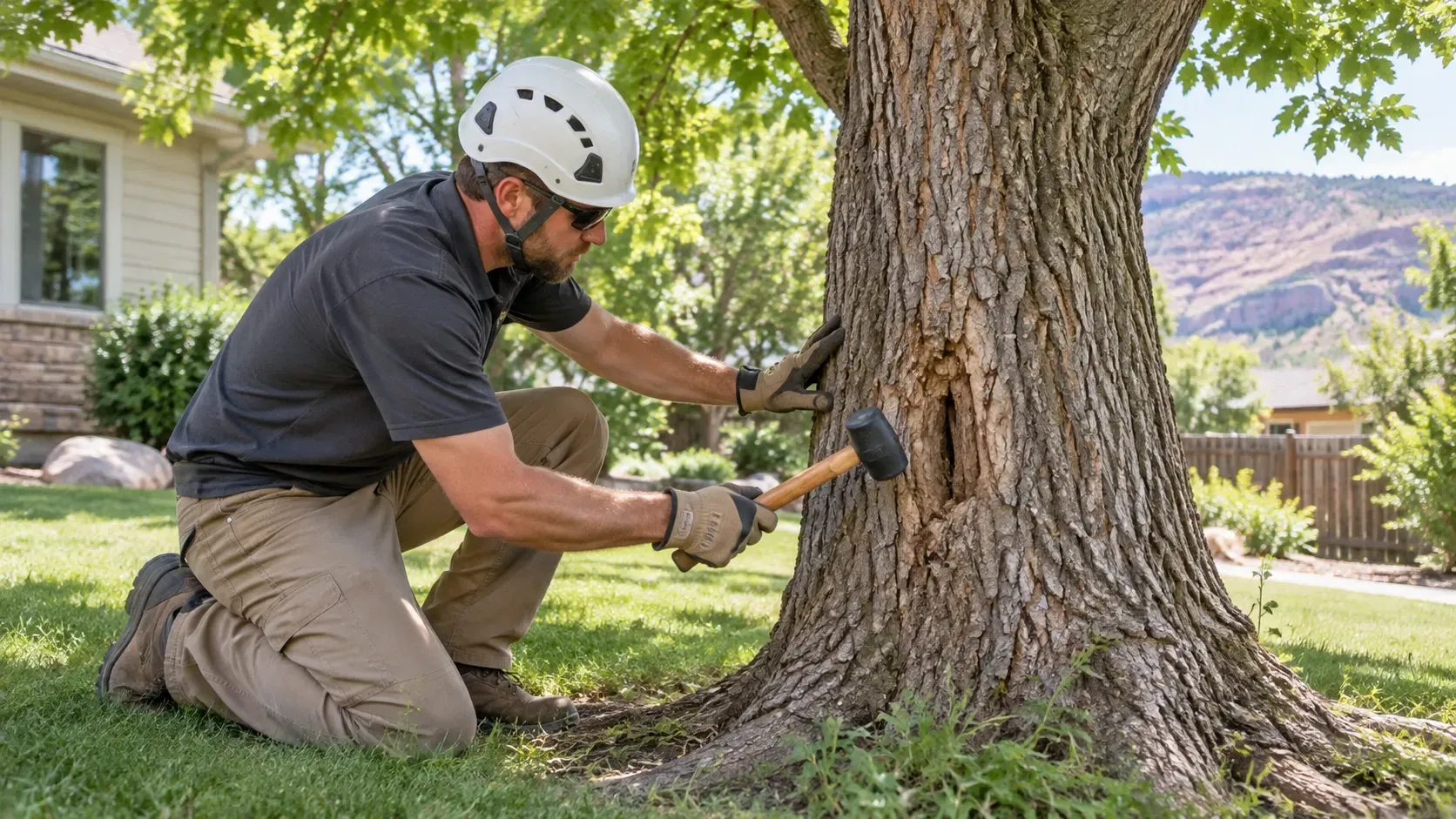
Table of Contents
- Introduction
- Why a Tree Can Look Healthy and Still Have Tree Rot
- Sapwood Does the Work, Heartwood Holds It Up
- What Decay Fungi Actually Eat
- Signs of Internal Tree Decay You Can Check Yourself
- Why Hidden Tree Rot Shows Up During a Storm
- How a Professional Finds Rot You Cannot See
- Conclusion
- Not Sure What Is Going On Inside Your Trees?
- Frequently Asked Questions
Key Takeaways
- A full green canopy proves the plumbing works. It says nothing about the column holding it up.
- The wood at the center of a trunk is already dead. Losing it to decay does not affect the leaves.
- A conk growing on a trunk means decay is established inside, not starting.
- Hollow does not automatically mean hazardous. How much sound wood is left is the real question.
- Storms do not create these failures. They reveal them.
Introduction
Yes, and it is far more common than homeowners expect: a tree can hold a full, green canopy while its trunk or main limbs are hollow, because the living tissue feeding those leaves is a thin layer just under the bark while the wood at the center is already dead, which is why a certified arborist looks at structure rather than foliage.
Leaves tell you the tree is alive. They do not tell you it is sound. Two different questions, and people run them together constantly.
Hidden tree rot is the reason.
Why a Tree Can Look Healthy and Still Have Tree Rot
Because the part that keeps a tree alive and the part that keeps it standing are not the same wood.
Think of a trunk as a pipe rather than a post. The living, working tissue is a narrow band near the outside: the cambium that grows new wood, and the sapwood just inside it that moves water up from the roots. That band is doing all the biology.
Everything inside that is heartwood. It is dead already, and it was dead before any fungus arrived. Its job is purely mechanical. It is the structural core.
So when decay takes the heartwood, the tree keeps doing everything you can see from the driveway. Water still moves, leaves still flush out in spring, the canopy still looks full in July. Nothing in the visible performance of the tree changes, because none of the living tissue has been touched.
What has changed is how much wood is left to resist bending.
Sapwood Does the Work, Heartwood Holds It Up
Here is the split, laid out plainly.
| Sapwood | Heartwood | |
|---|---|---|
| Living or dead | Living tissue | Already dead wood |
| Main job | Moving water and storing food | Structural support |
| Effect if damaged | Canopy thins, branches die back | No visible change at all |
| What you notice | Quickly, from the ground | Often nothing until failure |
Read that last row twice, because it is the whole article. Damage to the sapwood announces itself in the leaves. Damage to the heartwood announces itself when something lets go.
It is also why the usual seven signs of a dying tree, useful as they are, will not catch this particular problem. Those signs track a tree that is losing vitality. A hollow tree is not losing vitality. It is losing strength.
What Decay Fungi Actually Eat
Different fungi go after different parts of the wood, and it changes what the leftover wood behaves like.
Wood is mostly two things: cellulose, which gives it tensile strength, and lignin, which stiffens it. Decay fungi specialize.
- Some break down the lignin and leave wood that goes pale, soft, stringy and fibrous
- Others break down the cellulose and leave wood that goes brown, dry, and cracks into brittle little cubes that crumble between your fingers
That second kind is the one crews treat with the most caution. Wood that crumbles has essentially no strength left, and there can be a surprising amount of it behind an inch or two of perfectly sound outer shell.
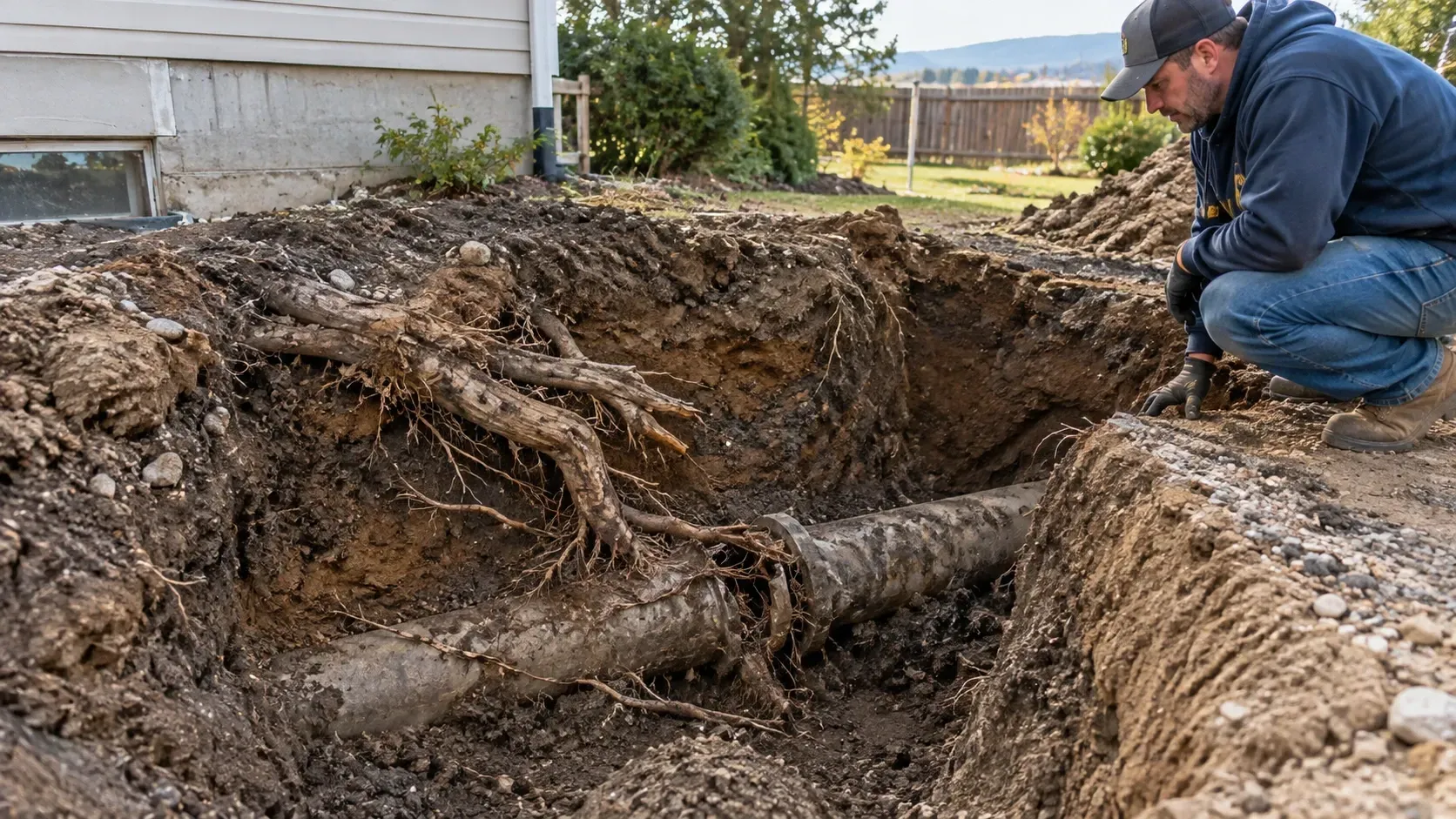
Decay almost always gets in through an opening. Storm tears, bad pruning cuts left flush to the trunk, old topping wounds, mower and trimmer damage at the base, or roots cut during trenching and construction. In the Grand Valley we see plenty of the last one, because irrigation work, driveways and additions all mean digging near trees that were there first.
Signs of Internal Tree Decay You Can Check Yourself
A short list, and what each one actually means rather than just that it is bad.
- A conk or bracket fungus growing on the trunk. This is the single most important one. A conk is the fruiting body, which means the fungus has been established inside the tree long enough to reproduce. Finding one is not an early warning. It is a late one.
- Mushrooms at the root flare or over the root zone. Same logic, pointed at the roots, which is worse because you cannot see root loss at all.
- A hollow or drummy sound when you knock along the trunk with your knuckles, compared with a solid section higher up.
- Carpenter ants coming and going, or fine sawdust at the base. Ants do not cause the decay. They move into wood that is already soft, which makes them a decent indicator.
- Deadwood high in the canopy while the lower canopy looks fine.
- A bulge, seam or flattened area on the trunk, which can be the tree laying down extra wood to compensate for weakness behind it.
That last one is worth dwelling on. Trees respond to internal weakness by growing more wood on the outside. A trunk that has gone oddly oval, or that has a vertical seam, may be a tree that has been quietly managing a problem for years.
Why Hidden Tree Rot Shows Up During a Storm
Because a storm does not cause these failures. It tests for them.
A tree with a compromised core stands fine in still air. It stands fine in ordinary wind. Then one day it gets a load it has not seen in a while, from a wet spring snow, a downslope wind, or a canopy full of water, and the remaining sound wood is not enough.
This is why the tree that comes down is so often the one nobody worried about. The obviously dying tree gets attention. The green one with a hollow trunk does not, right up until it is lying across something.
If you have a tree you would not want to lose a bet on, the time to look for tree rot is a calm week in winter, not during the event. That is the whole argument for a look before storm season.
How a Professional Finds Rot You Cannot See
Three methods, in order of how invasive they are.
Sounding. Working along the trunk with a mallet and listening for the change from solid to hollow. It is low tech, it is fast, and in experienced hands it finds most of what matters.
Probing. Where there is an existing opening or cavity, measuring how far a probe travels tells you how much of the cross section is gone.
Resistance drilling. A very fine needle driven slowly into the trunk while the resistance is recorded. It maps where the wood is sound and where it is not, along that one path, with a hole small enough not to matter to the tree.
What those produce is a picture of how much sound wood is left and where it sits, and that is the question that decides the outcome. Hollow does not automatically mean remove. Trees wall off decay and compartmentalize it, and plenty of hollow trees stand safely for decades. A shell of sound outer wood can be structurally fine, especially on a tree with nothing underneath it worth protecting.
What matters is how much is left, where the weak section sits, how the tree is loaded, and what is below it. Sometimes the answer is cabling and bracing or taking weight out of the canopy. Sometimes it is monitoring and nothing else. Sometimes it is tree removal, and we will say so plainly when it is. Where the trunk has already opened up, our look at split trunk causes covers how those get there.
Conclusion
Stop judging your trees by their leaves. Walk the trunks and the root flares of anything big enough to reach your house, your driveway or a place people sit, and look specifically for conks, soft spots and sounds that change as you move along the trunk. Green is not the same as sound, and the trees that come down in this valley are usually the ones that looked fine right up until they did not.
Not Sure What Is Going On Inside Your Trees?
If you have a big tree near the house and no idea what the inside of it looks like, have somebody put hands on it. Every job here begins with a full assessment from a certified arborist, and we will tell you honestly when the answer is to leave it alone and keep an eye on it. Tree Climbers Services is a dependable, fully insured local team with 14 years of combined experience, serving Grand Junction, Redlands, Fruita, Clifton and Montrose, with crews available 24/7 and transparent pricing with no surprises. Quotes are free and carry no obligation. Call (970) 589-2268 or
book a look.
Frequently Asked Questions
Can a tree be rotten inside and still have leaves?
Yes. The tissue that moves water and feeds the canopy is a thin living layer near the bark, while the heartwood at the center is already dead wood doing structural work. Decay can hollow the center without changing anything you see above.
Does a mushroom on a tree mean it is dying?
It means decay is established, not starting. A conk or bracket fungus is a fruiting body, so the fungus has been inside long enough to reproduce. Mushrooms at the root flare are more concerning still, since root loss is invisible from the ground.
Is a hollow tree always dangerous?
No. Trees compartmentalize decay and many hollow trees stand safely for decades. What matters is how much sound wood remains, where the weak section is, how the tree is loaded, and what sits underneath it. That needs assessing in person.
How do you check a tree for internal decay?
Sounding the trunk with a mallet and listening for hollow spots, probing any existing cavity to see how far it goes, and resistance drilling, which maps sound and decayed wood along a fine path with a hole small enough not to harm the tree.
What causes rot inside a tree trunk?
Decay fungi entering through a wound. Storm tears, flush or topping cuts, mower and trimmer damage at the base, and roots severed during trenching or construction are the usual doorways. The fungus then works on wood that was already dead.
Related Posts