Tree Trimming vs Tree Pruning: Understanding the Key Differences
Table of Contents
- Introduction
- What Is Tree Trimming?
- What Is Tree Pruning?
- Tree Trimming vs. Tree Pruning: What's the Difference?
- When Should You Trim or Prune a Tree?
- How Grand Junction's Climate Can Affect Tree Care
- Signs Your Tree Needs More Than Routine Trimming
- Common Tree Trimming and Pruning Mistakes
- When Is Tree Care Too Risky to DIY?
- Conclusion
- Need Professional Tree Trimming or Pruning?
- Frequently Asked Questions
Key Takeaways
- Tree trimming and tree pruning overlap, but they are not exactly the same type of tree care.
- Trimming generally focuses on controlling overgrowth, clearance, shape, and appearance, while pruning focuses more on tree health, structure, and risk reduction.
- Dead, damaged, diseased, crossing, or structurally weak branches may require pruning rather than simple cosmetic trimming.
- There is no universal trimming schedule that works for every tree. Species, condition, location, growth rate, and the reason for the work all affect timing.
- Grand Junction's dry conditions, temperature swings, wind, and occasional winter weather make tree condition and structural stability important considerations.
- Cutting too much at once, topping a tree, or making poor cuts can create problems that are harder to correct later.
- Large branches, trees near structures, damaged trees, and work around utility lines should be evaluated by a qualified professional.
Introduction
Tree trimming controls unwanted growth and clearance, while tree pruning focuses more specifically on removing branches that affect a tree's health, structure, or safety. The terms are often used interchangeably, but knowing the difference can help Grand Junction homeowners choose the right type of care instead of cutting branches simply because they look overgrown.
The distinction matters because the wrong cut can create a larger problem than the branch that was removed. A tree may need a small amount of shaping, selective removal of deadwood, structural correction, or a more detailed assessment depending on what is happening in the canopy.
Grand Junction properties also have local considerations. Dry conditions, temperature changes, wind, and seasonal weather can place additional stress on trees and make weak or poorly attached branches more concerning.
If your tree has become overgrown or has branches that are creating a safety or clearance problem, professional tree trimming services can help determine which branches should actually be removed rather than treating every overgrown tree the same way. Tree Climbers Services states that its tree trimming work can address shape, health, safety, hazardous limbs, structural pruning, and canopy management.
What Is Tree Trimming?
Tree trimming generally refers to removing or shortening unwanted growth to manage a tree's size, shape, clearance, or appearance.
For example, trimming may be appropriate when branches:
- Extend into a walkway or driveway
- Interfere with a structure
- Grow into an area where they create a clearance problem
- Make the canopy excessively dense
- Have grown beyond the desired form of the tree
- Need selective reduction to maintain usable space around the property
The important point is that trimming should not mean cutting back as much as possible.
A common misconception is that a tree should be cut heavily whenever it looks overgrown. Removing large amounts of live growth at once can stress a tree and may encourage poorly attached regrowth.
Good trimming starts with a reason for each cut.
Before removing a branch, consider:
- Why does this branch need to come off?
- Is the problem cosmetic, structural, or safety-related?
- Can the objective be achieved by removing a smaller branch instead?
- Will removing the branch create a larger structural problem?
- Is the tree healthy enough to tolerate the proposed work?
That decision-making process is more important than simply making the canopy look smaller.
What Is Tree Pruning?
Tree pruning is the selective removal of branches to address tree health, structure, growth, or safety.
Pruning may involve removing:
- Dead branches
- Broken branches
- Diseased or declining wood
- Branches that cross or rub against one another
- Poorly attached branches
- Structurally problematic growth
- Selected branches that interfere with the tree's long-term form
Pruning is therefore less about making a tree look uniformly neat and more about making deliberate cuts that support the tree's long-term condition.
This is where professional assessment becomes particularly valuable. Two branches can look equally unnecessary from the ground while having very different structural importance.
A professional also considers the size and position of the branch, the tree's structure, nearby property, access, and the potential consequences of removing it.
Tree Trimming vs. Tree Pruning: What's the Difference?
The simplest distinction is:
Trimming manages unwanted growth and clearance. Pruning selectively removes branches for health, structure, and safety.
| Factor | Tree Trimming | Tree Pruning |
|---|---|---|
| Main goal | Manage size, shape, and clearance | Improve health, structure, and safety |
| Typical focus | Overgrown or obstructive growth | Dead, damaged, weak, crossing, or problematic branches |
| Primary concern | How the tree is growing into its surroundings | How the tree is growing and functioning as a whole |
| Can it be cosmetic? | Often | Not necessarily |
| Requires assessment? | Yes, especially for mature trees | Yes, particularly for structural work |
| Can it involve large branches? | Sometimes | Yes, but large cuts require careful evaluation |
The two practices can also happen during the same service.
For example, a tree may have branches growing over a roof while also containing deadwood and weakly attached limbs. The work may therefore involve both clearance-oriented trimming and health- or structure-oriented pruning.
This is why homeowners do not always need to decide on the terminology themselves. A professional assessment can determine what the tree actually needs.
When Should You Trim or Prune a Tree?
There is no single month that is automatically correct for every tree.
The best timing depends on the tree species, its condition, the reason for the work, local weather, and whether a hazard needs immediate attention.
When trimming may be appropriate
Routine trimming can be planned when the tree has developed growth that:
- Interferes with a structure
- Blocks a walkway or access area
- Creates unwanted clearance problems
- Has become excessively dense
- Is growing in an undesirable direction
The goal should be to address the specific problem without removing healthy growth unnecessarily.
When pruning may be necessary
Pruning becomes more important when the tree has:
- Dead or broken branches
- Branches rubbing against one another
- Structurally weak growth
- Storm damage
- Signs of decay
- Growth that creates an obvious hazard
Hazardous or damaged branches should not simply be left in place until a convenient seasonal pruning window if they pose an immediate risk to people or property.
Don't rely on a calendar alone
The original assumption that trimming should always happen during spring and summer and pruning should always happen during late winter is too broad.
Different trees have different growth patterns and pruning requirements. Flowering trees, fruit trees, young trees, mature trees, and trees affected by damage may require different approaches.
The better question is not:
"What month is it?"
It is:
"What does this tree need, what species is it, what is its condition, and what is the reason for making the cut?"
That produces a much more useful tree-care decision.
How Grand Junction's Climate Can Affect Tree Care
Tree care in Grand Junction should account for local environmental conditions rather than relying entirely on a generic pruning calendar.
Dry conditions can increase stress
Trees growing under water stress may be less resilient to additional disturbance. Homeowners should consider the tree's overall condition before undertaking significant live-branch removal.
Wind can expose structural weaknesses
Strong winds can place substantial force on branches and branch unions. A limb that already has a weak attachment, crack, or other structural problem deserves closer attention before the next major weather event.
Temperature changes matter
Colorado's temperature fluctuations can make timing more complicated than simply choosing a standard spring or summer date. Recent weather and the tree's condition should be considered before significant work is planned.
Winter weather can reveal problems
Snow and winter conditions can expose weak branch structure or increase the load on existing defects. After a significant weather event, look for hanging limbs, fresh breaks, cracks, or branches resting on structures.
If a branch is visibly damaged or threatening a house, vehicle, power line, or frequently used area, treat it as a safety issue rather than waiting for the next routine maintenance appointment.
Tree Climbers Services identifies Grand Junction and surrounding communities including Fruita, Clifton, Orchard Mesa, and Palisade as part of its service area.
Signs Your Tree Needs More Than Routine Trimming
A tree that simply looks untidy is different from one showing signs of a developing structural or health problem.
Pay closer attention when you notice:
Dead branches throughout the canopy
A small amount of deadwood can occur naturally, but widespread dead branches may indicate declining tree health or another underlying problem.
Large broken limbs
Large broken branches can change the balance and structure of the canopy. They may also create an immediate falling hazard.
Cracks or splits
A visible crack in a major branch or trunk deserves professional attention, particularly when the crack is associated with a heavy limb or an area frequently used by people.
Branches rubbing against one another
Repeated contact can damage bark and create wounds that may become more problematic over time.
Weak branch attachments
Some branches develop narrow or compromised attachment points. Removing or reducing the right branch may sometimes reduce risk, but the decision should be based on the tree's structure rather than appearance alone.
A tree leaning toward a target
A leaning tree is not automatically dangerous, but a significant lean combined with root problems, cracking, soil movement, or recent damage warrants assessment.
If you notice major structural problems, the issue may be more than routine trimming. Tree Climbers Services also provides tree removal for trees that have become hazardous because of damage, disease, age, or location.
Common Tree Trimming and Pruning Mistakes
Topping the tree
Topping removes large portions of the canopy to reduce a tree's height.
It may make a tree appear smaller temporarily, but it can leave large wounds and encourage weakly attached new growth. Reducing a tree's size should involve a more selective strategy whenever possible.
Removing too much live growth
More cutting is not necessarily better.
Removing excessive canopy can stress the tree and reduce the foliage available for normal growth. A homeowner should not assume that a heavily cut tree is a healthier tree.
Cutting without understanding the branch collar
Where a branch is removed matters. Poorly placed cuts can damage the trunk or leave an unnecessarily large stub.
Using contaminated or poorly maintained tools
Dirty or poorly maintained cutting tools can produce poor-quality cuts and potentially spread problems between trees.
Treating every tree the same way
A young ornamental tree, mature shade tree, fruit tree, and damaged tree should not automatically receive the same pruning strategy.
Cutting simply because a branch looks inconvenient
A branch may look awkward without actually being a problem. Before removing it, determine whether it affects clearance, structure, health, or safety.
The better approach is to define the objective first and then make the minimum necessary cuts to accomplish it.
When Is Tree Care Too Risky to DIY?
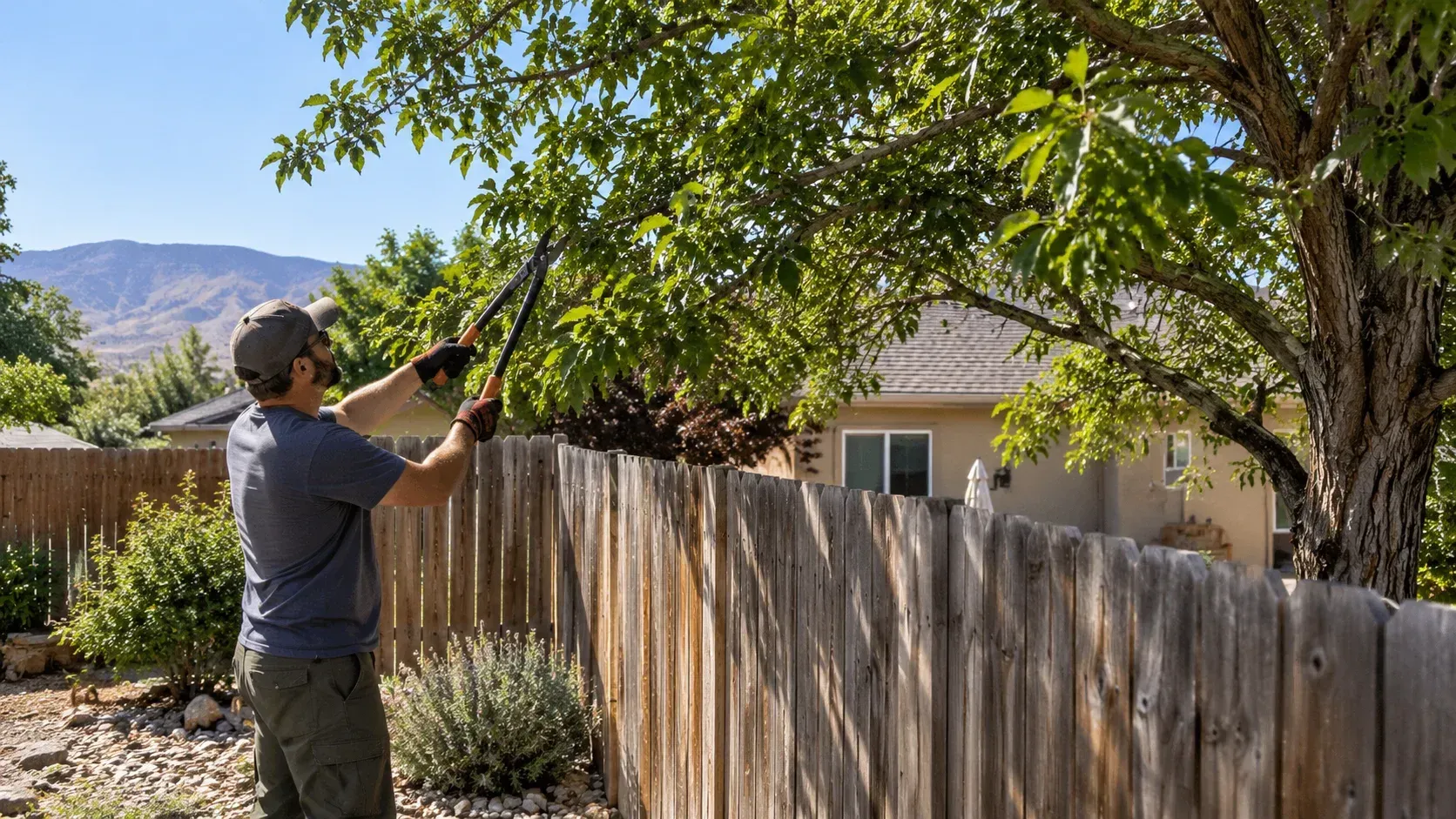
Small, reachable branches may be manageable for a knowledgeable homeowner using the right equipment and technique. The risk changes significantly when the work involves height, heavy limbs, unstable trees, or nearby structures.
Professional help is appropriate when:
- Large branches need to be removed
- Branches are above a roof or other structure
- The tree has significant storm damage
- The tree is leaning or structurally compromised
- Work requires climbing
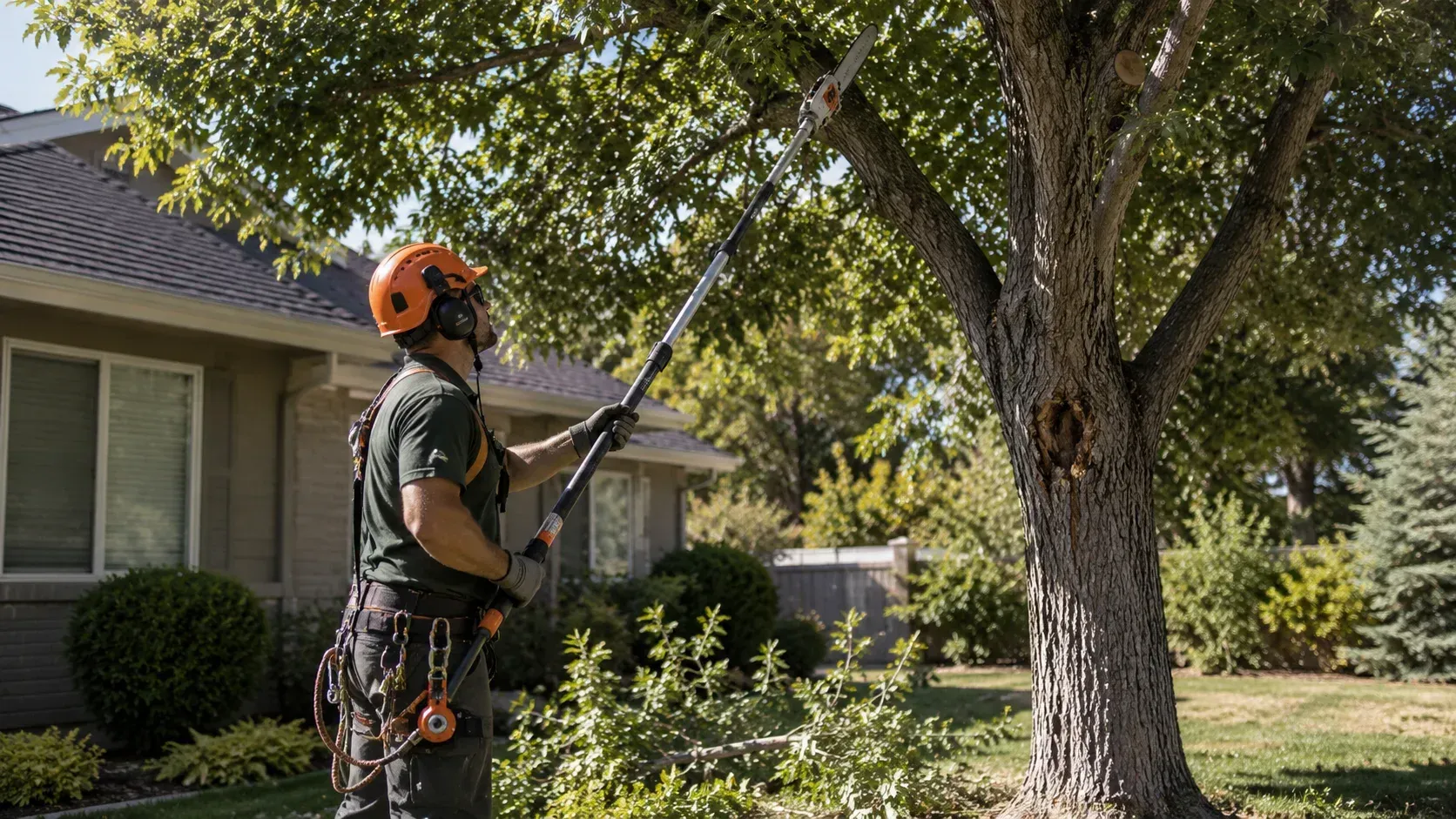
- A chainsaw must be used at height
- Utility lines are nearby
- You cannot determine which branches are safe to remove
- A branch is hanging or partially broken
One of the biggest DIY mistakes is focusing only on the branch being cut and not on where that branch will fall.
A large limb can damage a roof, vehicle, fence, landscaping, or another tree even when the cut itself appears straightforward.
Professional tree care also involves planning the work area, selecting appropriate equipment, controlling the direction of falling material, and protecting people and property.
Conclusion
Tree trimming and tree pruning are related but serve different purposes. Trimming generally addresses unwanted growth, clearance, size, and appearance, while pruning focuses more on health, structure, and safety.
For Grand Junction property owners, the most important decision is not choosing the correct term. It is identifying why the tree needs work and which branches actually need to be removed.
Avoid topping, excessive cutting, poorly placed cuts, and DIY work involving large or hazardous branches. If a tree has deadwood, storm damage, structural problems, or branches threatening a structure, a professional assessment can help determine whether selective pruning, trimming, or a more extensive solution is appropriate.
Need Professional Tree Trimming or Pruning?
If you're unsure whether a tree needs routine trimming, structural pruning, or a closer safety assessment, the right first step is to have the tree evaluated rather than removing branches at random. You can request a tree service estimate from Tree Climbers Services to discuss the condition of your trees and determine the appropriate next step. The company serves Grand Junction and surrounding communities in Western Colorado.
Frequently Asked Questions
Is tree trimming the same as tree pruning?
No. The terms are often used interchangeably, but trimming generally focuses on managing unwanted growth, shape, size, and clearance, while pruning is more focused on tree health, structure, and safety.
What is the best time of year to prune trees?
There is no single best time for every tree. Timing depends on the species, tree condition, reason for pruning, and local conditions. Dead, broken, or hazardous branches may need attention regardless of season.
How do I know if my tree needs pruning or trimming?
Look at the reason for the work. If the main issue is overgrowth, clearance, or appearance, trimming may be appropriate. If you see dead, damaged, crossing, weak, or structurally concerning branches, pruning may be more appropriate.
Can trimming a tree damage it?
Yes. Removing too much live growth, topping a tree, making poor cuts, or cutting without considering the tree's structure can cause unnecessary stress and create long-term problems.
Can I trim large tree branches myself?
Large branches should generally be left to trained professionals, particularly when they are high above the ground, close to structures or utility lines, or already damaged. The risks include falling limbs, chainsaw injuries, and property damage.
Related Posts